
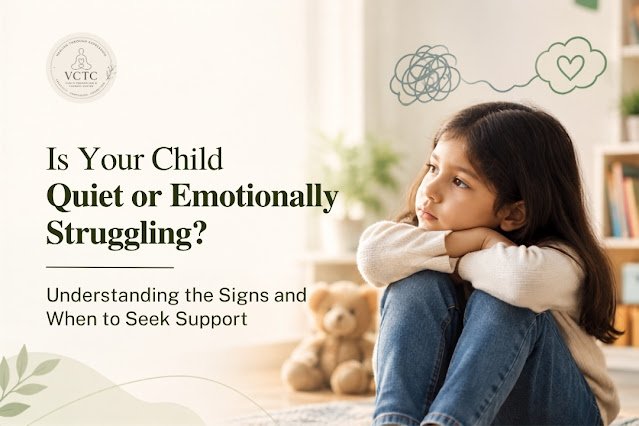
Children do not always have the words to explain what they are feeling.
A child who becomes unusually quiet may simply have a naturally calm personality, but sometimes silence can also be a sign of emotional stress, anxiety, sadness, loneliness, fear, or difficulty adjusting to a situation.The challenge for parents is understanding the difference between a child's natural temperament and a meaningful change in emotional behaviour.
We often focus on whether a child is eating well, attending school, completing homework, and behaving appropriately at home. However, emotional wellness deserves the same attention. Changes in communication, friendships, confidence, sleep, play, or everyday behaviour can sometimes tell us that a child may need additional emotional support.
For families looking for Child and Adolescent Counseling in Nagpur, understanding these early signs can be an important first step. Professional counselling can provide children and parents with a safe environment to understand emotions, communication patterns, and behavioural changes without immediately labelling the child.
Is Your Child Naturally Quiet or Is Something Different?
Some children are naturally introverted, observant, or comfortable spending time by themselves. Being quiet does not automatically mean that a child is emotionally struggling.
The more important question is whether there has been a noticeable and persistent change in the child's usual behaviour.
For example, a child who has always preferred quiet activities may simply have a different personality. However, if a previously talkative child suddenly stops communicating, avoids friends, loses interest in favourite activities, or appears worried or withdrawn, it may be worth exploring what has changed.
Parents can gently observe rather than immediately question or pressure the child.
Instead of repeatedly asking, “What is wrong with you?”, a supportive approach could be, “I have noticed that you have been quieter lately. I am here if you want to talk.”
This communicates safety rather than judgement.
Common Signs of Emotional Struggle in Children
Emotional difficulties can appear differently at different ages. Some children become withdrawn, while others become unusually angry, restless, argumentative, or emotionally sensitive.
Parents may notice:
- Sudden withdrawal from family members
- Loss of interest in hobbies or play
- Avoiding friends or social situations
- Frequent crying or emotional outbursts
- Increased irritability or anger
- Excessive worrying
- Fear of going to school
- Changes in sleeping patterns
- Changes in appetite
- Difficulty concentrating
- Drop in academic performance
- Frequent physical complaints without an obvious cause
- Low confidence or negative self-talk
- Excessive perfectionism
- Increased dependence on parents
- Reluctance to communicate
- Changes in normal routines or behaviour
One sign alone does not necessarily indicate an emotional disorder. What matters is the pattern, intensity, duration, and impact on the child's everyday life.
Why Children May Find It Difficult to Talk About Their Feelings
Adults often assume that children will simply tell us when something is bothering them. In reality, many children do not know how to describe complex emotions.
A child may feel anxious without understanding what anxiety is. They may feel lonely but be unable to explain why. They may be experiencing bullying, friendship problems, academic pressure, family changes, or worries about fitting in but fear disappointing their parents.
Some children also believe that talking about their emotions will create additional problems.
Others may communicate their distress through behaviour instead of words.
A child who says, “I don't want to go to school,” may not simply be avoiding school. There could be an emotional reason behind the behaviour that needs to be understood.
This is why listening to the message behind the behaviour can be more helpful than focusing only on correcting the behaviour.
How Parents Can Encourage Emotional Communication
Children are more likely to talk when they feel that they will be listened to rather than immediately corrected.
Parents can encourage communication by creating small, regular opportunities for conversation.
Instead of turning every conversation into an interrogation, try talking while doing an everyday activity together—such as travelling, preparing food, walking, drawing, or playing.
Open-ended questions can also help:
- “How was your day today?”
- “Was anything difficult today?”
- “What was the best part of your day?”
- “Did anything make you uncomfortable?”
- “Is there something you wish adults understood better?”
- “What would help you feel better?”
Most importantly, allow the child enough time to respond.
Sometimes children need several conversations before they feel ready to share something important.
The Role of Child and Adolescent Counseling in Nagpur
Child and Adolescent Counseling in Nagpur can provide age-appropriate emotional support for children and teenagers experiencing difficulties at home, at school, socially, or internally.
Counselling for children is not simply a smaller version of adult therapy. Children communicate differently, and their emotional world can often be explored through conversation, play, drawing, storytelling, creative activities, and other age-appropriate approaches.
A trained professional can help understand the child's concerns while also helping parents understand how they can provide appropriate support at home.
The goal is not to label a child as “problematic.” Instead, counselling can help identify what the child may be experiencing and develop healthier ways of coping and communicating.
Mental Health and Emotional Wellness Counseling in Nagpur
Mental health is not only about treating serious psychological conditions. It also involves emotional awareness, resilience, healthy relationships, confidence, communication, coping skills, and the ability to manage everyday challenges.
Mental Health and Emotional Wellness Counseling in Nagpur can support children and adolescents as they navigate emotional and developmental changes.
Teenagers, in particular, may face academic expectations, peer pressure, social media influence, changing friendships, body-image concerns, identity questions, and uncertainty about the future.
A supportive counselling environment can give them an opportunity to express themselves without feeling that every conversation needs to become a lecture from an adult.

Can Art Therapy Help a Quiet Child?
For some children, talking directly about emotions can feel uncomfortable. Creative expression may offer another way to communicate.
An Art Therapist in Nagpur may use drawing, painting, colours, storytelling, visual activities, or other expressive techniques as part of an appropriate therapeutic approach.
A child may find it easier to draw a picture of what they are feeling than to explain it verbally. Another child may use colours, characters, or stories to communicate experiences that are difficult to discuss directly.
Art therapy is not about judging artistic ability. A child does not need to be “good at art” to participate.
The creative process can provide opportunities for emotional expression, reflection, communication, and self-awareness.
However, artwork should not be treated as a diagnostic test where a particular colour or drawing automatically indicates a specific psychological problem. Meaning should always be understood in the context of the individual child, their experiences, and professional therapeutic assessment.
When Should Parents Consider Professional Support?
Parents do not need to wait until a child's difficulties become severe before seeking guidance.
Professional support may be worth considering when emotional or behavioural changes are persistent, becoming more intense, or interfering with school, friendships, family relationships, sleep, activities, or everyday functioning.
It can also be helpful when parents feel unsure about how to respond to a child's behaviour.
Seeking counselling does not mean that parents have failed or that something is “wrong” with the child. Emotional support can simply provide another layer of guidance during a challenging period.
Early attention can sometimes make it easier for a child to develop healthy communication and coping skills before difficulties become more deeply established.
How Schools, Parents and Counsellors Can Work Together
Children spend a significant part of their lives in school, making communication between parents, teachers, and appropriate professionals valuable when concerns arise.
Teachers may notice changes in classroom participation, friendships, concentration, confidence, or academic performance before parents notice similar changes at home.
Parents, meanwhile, may observe changes in sleep, family interaction, appetite, mood, and behaviour outside school.
When appropriate and with suitable privacy and consent, bringing these observations together can help adults understand the child's situation more completely.
The focus should always remain on supporting the child rather than blaming them.
Helping Children Feel Seen, Heard and Understood
Children need more than instructions and discipline. They also need opportunities to feel understood.
A quiet child may not need to be pushed into becoming more talkative. Instead, we can try to understand what their silence means within their individual circumstances.
Sometimes silence is simply personality. Sometimes it is a temporary response to change. And sometimes it may be the way a child communicates that something feels difficult.
The most helpful response is curiosity, patience, and emotional availability.
By creating a home environment where feelings can be discussed without shame, parents can help children understand that asking for support is not a weakness.
Building Emotional Wellness From an Early Age
Emotional wellness is a skill that develops over time. Children can learn to identify feelings, communicate needs, manage disappointment, handle conflict, build confidence, and seek support when they need it.
Parents do not have to have every answer. What matters is being willing to listen and seek appropriate professional guidance when necessary.
Whether a family is exploring Child and Adolescent Counseling in Nagpur, looking for Mental Health and Emotional Wellness Counseling in Nagpur, or considering support from an Art Therapist in Nagpur, the first step is understanding the child's individual needs.
A quiet child is not necessarily an unhappy child. But a significant or lasting change in behaviour deserves attention.
Sometimes, the most powerful message a parent can give is simple:
“You don't have to explain everything right now. I am here, and we can figure it out together.”
Creating that sense of safety can be the beginning of healthier communication, stronger emotional awareness, and greater confidence as a child grows into adolescence and adulthood.

Contact Vani's Counseling & Therapy Centre
Call: +91 95294 31886
Website: vanijog.com
Address: Vani's Counseling & Therapy Centre, Room 5, 1st Floor, Purva Vidarbha Mahila Parishad, New Ramdaspeth, Nagpur, Maharashtra 440010.